
Receive our offers and promo codes by email Subscribe to the newsletter
Models & specificities
Descriptive
Reviews
A question
Besoin de formation
Models & specificitiesDescriptiveReviewsA questionBesoin de formation
Models & specificities
Back to menu
Reference
Price inc VAT
Maxi length (cm)
Price inc VAT
51564
£83.42
200
£83.42
Models & specificitiesDescriptiveReviewsA questionBesoin de formation
Descriptive
Back to menu
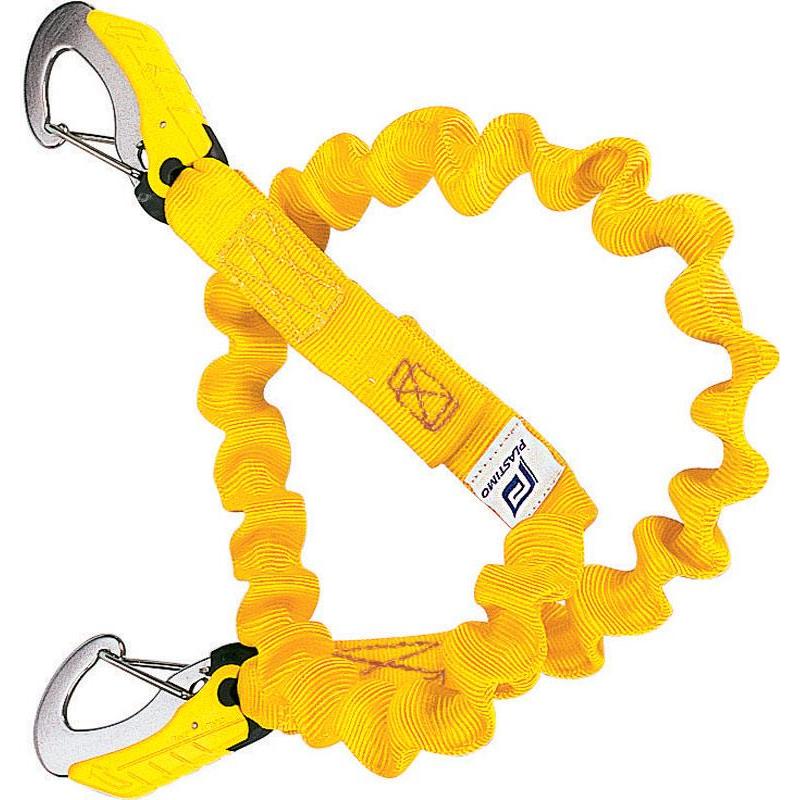
When the lanyard is subjected to an excessive load (for example during a fall), the overload indicator comes undone and reveals a label indicating that the lanyard must be replaced.
The lanyard is an essential complement to the inflatable vest. Provided, of course, that you have chosen a vest model « with harness », which has a buckle necessary for attaching the lanyard and which, above all, provides the required strength. It is essential to ensure good compatibility between a harness and its lanyard, particularly in terms of strength, and therefore not to « jury‑rig » a lanyard; these strengths are determined by the reference standard and by the age of the harness: the ageing of the webbing, even if visually imperceptible, should not be ignored.
A lanyard is characterized by: • Number of legs: a double lanyard has 2 legs. It allows you to remain continuously attached even when moving.
• Number of carabiners: there is not necessarily a carabiner at each end; the lanyard can be integrated into the harness by a loop.
• Length of the legs: the standard length is 2 m, but when a lanyard is double, the 2nd leg is reduced to 1 m to allow for a tight attachment. The principle of a harness is to prevent falling overboard: it should therefore be as short as possible and worn as often as possible. Lanyards are shorter on children's harnesses.
• Elasticity: the presence of an elastic is an undeniable comfort feature since the strap is « shortened » for movement. Quieter and less restrictive to movement, the extendable lanyard is the model chosen by sailors who regularly wear their harness.